

-
Top offers
-
Bikes
-
Accesories


Availability
Brand
Price
Selections
diameter
Rigid Forks
Rigid MTB forks, meaning non-suspension forks for mountain bikes, affect steering precision, bike weight and the overall character of the ride in terrain. In this category, you will find rigid MTB forks for different types of hardtail and specific MTB builds, varying by material, compatibility and intended use.
Sort by:

Rigid MTB forks: compatibility, advantages and correct selection
Advantages of a rigid fork | Compatibility and geometry | Material, axle and steerer
A rigid MTB fork is not the right choice for everyone, but in the right setup it makes very good sense. Compared to a suspension fork, it brings lower weight, simpler construction, lower maintenance demands and more direct front-end feedback. It is most commonly used on lighter hardtails, bikepacking builds, some XC bikes, or wherever the goal is a mechanically clean and durable setup without suspension service.
At the same time, a rigid fork does not absorb impacts like a suspension fork. Its value is therefore not just that it is “simpler”, but that it suits a specific bike type, terrain and riding expectation. When chosen correctly, it works very well. When compatibility or fork height is overlooked, it can unnecessarily compromise both geometry and ride feel.
Where a rigid MTB fork makes sense
The main advantage of a rigid MTB fork is simplicity. There are no suspension service intervals, the bike is usually lighter, and the front end feels more direct. This makes the most sense when building a bike for XC, bikepacking, less aggressive trail use, winter riding or a versatile hardtail, where reliability and a clean setup matter more than extra front-end travel.
In practice, the difference shows up in the fact that a rigid fork keeps the front end precise, but transfers more of the terrain directly into the bars and steering. That is why the key question is not only whether it fits the bike, but also whether it matches the intended riding style. For fast rough descents and harsh terrain, suspension is usually the more logical option. For an efficient, light and mechanically simple bike, a rigid fork can be exactly the right solution.
What to check so the fork actually fits
- Wheel size – the fork must match the wheel size, typically 27.5" or 29". This is not only about tyre clearance, but also about correct front-end height and sensible geometry.
- Axle-to-crown / fork height – this is a critical parameter with rigid MTB forks. If you are replacing a suspension fork, the new rigid option should match the height of the original setup as closely as possible. This is where the term suspension corrected becomes important. A fork that is too short or too tall can change the head angle, front-end height and the way the bike behaves in corners and climbs.
- Steerer tube – straight or tapered must match both the frame and the headset. This is one of the most common compatibility mistakes when buying a fork.
- Axle standard and hub spacing – boost or non-boost, QR or thru-axle. If the axle standard and spacing do not match, the front wheel will not fit. That is why it makes sense to check related MTB hubs as well.
- Brake mount standard – verify what brake mount the fork uses and whether it matches the rest of the front-end setup. With fork replacement, this matters just as much as axle or steerer compatibility.
- Offset and overall geometry – besides height, the fork also affects front-end tracking and steering behaviour. With a rigid MTB fork, this can be more noticeable than with a like-for-like suspension swap, because you are working with a fixed front-end geometry and no sag.
Material and intended use
A carbon rigid fork makes sense where lower weight, a sportier ride feel and some filtering of smaller vibrations matter most. Steel or more robust alloy options usually make more sense where durability, higher loads or harder use are the priority. With a rigid MTB fork, material choice is not only about weight, but also about how the bike will actually be used and what you expect from it over time.
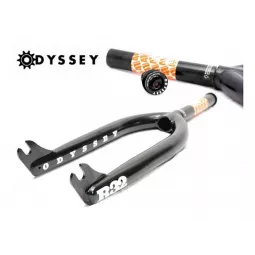
This category naturally includes brands with different characters. Identiti and NS Bikes make sense for MTB and dirt-oriented builds, Gusset leans toward durability and function, BOX Components is more relevant for lighter or race-oriented use, while Odyssey BMX is more of a niche overlap from a brand otherwise closely tied to BMX. The point of mentioning brands here is not to list logos, but to help clarify whether you are looking for a lighter XC / bikepacking direction or a more robust, harder-use setup.
Practical note: the most common mistake with rigid MTB forks is focusing only on whether the fork is “for 29” or whether the axle looks correct. In real use, the deciding factors are often fork height, steerer type and how the fork works with the frame geometry. If only part of the parameters match but axle-to-crown does not, you may still be able to build the bike, but it may not ride the way it should.
If you want a broader comparison within the overall segment, take a look at the parent category MTB forks.
Does a rigid MTB fork make sense instead of a suspension fork?
Yes, if it suits the purpose of the bike. A rigid fork makes sense where lower weight, simplicity and lower maintenance are the priority. For regular riding in harsh and rough terrain, a suspension fork will usually remain the more logical choice.
How do I know if a rigid MTB fork will be compatible with my bike?
Check the wheel size, fork height, steerer type, axle standard and brake mount. With rigid MTB forks, axle-to-crown is especially important because it directly affects bike geometry.
What does suspension corrected mean?
Suspension corrected describes a rigid fork designed with a height intended to reasonably replace a suspension fork of a certain travel range. The goal is to keep the bike geometry as close as possible to the original setup.
What type of riding is a rigid MTB fork suitable for?
Most commonly for XC, bikepacking, versatile hardtail builds, lighter trail use and riding where simplicity and reliability matter most. The rougher and faster the terrain, the more important it is to consider the limits of a rigid setup.